Skip to content
Jonas Plewka

Assessment for small businesses

A full working day a week disappears between sticky notes and software.

Not because anyone is slow, but because at every handover something gets retyped or chased up. I find those points and tell you what they cost.

3 hours on site · findings within 5 working days · €480 net

Find nothing, pay nothing.

Four details, no payment in the form. I get back to you within one working day.

The voice in the film is AI-generated.

What the film says

The doors closed hours ago. But at the desk, the second shift is just beginning.

The enquiry came in by phone and sits on a sticky note. The quote gets typed from scratch again. One appointment takes three phone calls. And the invoice gets written at night, from memory.

Something gets stuck at every handover. Together, that easily adds up to a full working day a week.

Jonas Plewka looks at your working day and writes down what eats up time, and how much. And what can be fixed, and what cannot.

Then, if you like, he builds what follows from it. Enquiries stop ending up on sticky notes, and the handovers run on their own.

You can see at a glance that everything is running. And your evenings are yours again.

The first step is the assessment. You can book it right here on this page.

Example

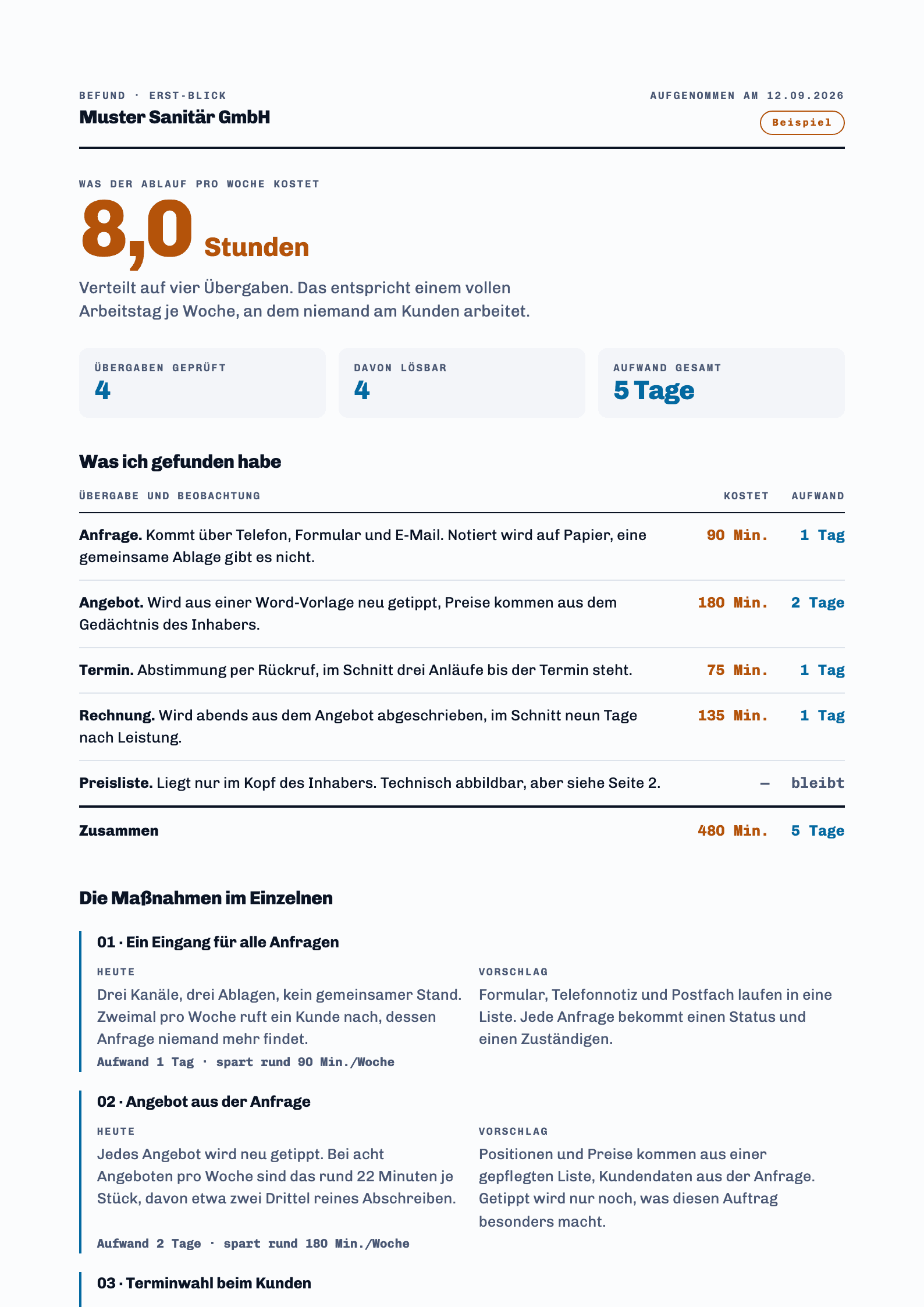
How work moves through a business, in four stations: enquiry, quote, appointment, invoice. A line runs between the stations, and at each of the four it backs up. The enquiry costs 90 minutes per week, the quote 180, the appointment 75 and the invoice 135. Together that is eight hours a week, a full working day.

  1. Enquiry

    Comes in by phone, ends up on a sticky note

    90 min./week

  2. Quote

    Retyped every time, prices from memory

    180 min./week

  3. Appointment

    Three calls back and forth before it is set

    75 min./week

  4. Invoice

    In the evening, from memory, often late

    135 min./week

Together8hours per weekA worked example with four handovers. Your numbers go into your own findings after the visit. (480 Min.)

What I set up

The standard cases run, and so do the odd ones.

Most of what eats time is standard and long since solved. That part I simply set up. It gets interesting where no off-the-shelf tool fits.

  • Inbox and enquiries

    Enquiries sort themselves and land with whoever answers them.

    • Enquiries from form, phone and email in one place
    • Standard replies that write themselves
    • Routing by topic instead of by chance
  • Scheduling and calendars

    Customers book themselves, without anyone calling back three times.

    • A booking page with your real availability
    • Reminders by email or text before the appointment
    • Cancellations and changes without a phone call
  • Quotes and invoices

    Built from what is already in the system, not from memory.

    • Quote from the enquiry, without retyping
    • Invoice from the quote, without retyping
    • Payment reminders that go out on their own
  • Customer data

    Entered once, correct everywhere, without dead records.

    • Change an address once and it changes everywhere
    • Find duplicates and merge them
    • Full history for a customer at a glance
  • Connecting programs

    Two systems that do not talk to each other, made to talk.

    • Data from one program into the other, automatically
    • Figures to accounting and your tax advisor, without retyping
    • Connection to a shop, website or portal
  • Numbers and reports

    The report is there on Monday without anyone building it.

    • Revenue, capacity and open items kept current
    • A report that sends itself
    • An alert when a number moves out of range

And the cases nothing off the shelf covers.

If the way you work has a quirk no standard tool handles, it gets built. The three tools below came about exactly that way.

What you get

Findings that get you somewhere even without me.

No proposal, no slide deck. Three pages listing your handovers, each with the time it costs and the effort in days.

  • Every measure with its effort in days
  • Including what should stay as it is, and why
  • Written so that anyone else can work from it
View the full example as PDF

Three pages, 220 kB. The business and figures are invented, the layout is real.

First page of a sample findings document: header with business and date, the headline figure of eight hours per week, three key figures and a table of four handovers with time lost and effort.

How it works

Three steps, then you have it in writing.

  1. 01

    We walk through it

    On site or on screen. You show me an ordinary working day.

  2. 02

    I write it up

    The findings reach you within 5 working days.

  3. 03

    You decide

    Do it yourself, hire someone, or leave it. All three are fine.

What it costs

€480

net, plus 19 % VAT (€571.20 gross)

For that: 3 hours on site and the finished findings.

One price, one invoice, no subscription. If I find nothing, I tell you so and you pay nothing.

If you want it implemented

Implementation is a separate project with its own quote. You tell me which measures from the findings you want implemented, and you get a price for them before you commission anything.

What I work with

Three things I built for myself.

I do not show client projects, I lack permission. Instead, three tools of my own that I use daily.

Gather

Research that runs overnight

Finding, checking and rating companies without anyone sitting there.

6check stages

What it does

A list of businesses goes in, the same list comes out with a rating: size, region, trade, how active, fits or does not. Six stages, each checking something different.

What it replaces

Ten minutes per business by hand: search, read the site, read the legal notice, take notes. After thirty of them nobody carries on.

Produce

Documents that typeset themselves

Existing data goes in, a finished, designed PDF comes out.

What it does

Content in, finished document out: quote, report, application. With margins, typography and a cover. Not one you still have to straighten out.

What it replaces

The text is done after twenty minutes. Then two hours go into formatting that starts from scratch on the next document.

Remember

A memory that never asks twice

Every decision written down once and never argued again.

217sheets

What it does

A store of single sheets: what was decided, why, and what went wrong. Found through an index instead of through recollection.

What it replaces

Why did we set this customer's price that way, why do we only deliver there on Thursdays? Two years on nobody remembers, so we settle it again, often differently.

Questions that come up first

What you are probably thinking right now.

I do not really have proper software. Is this still worth it?

Usually more so. If you work with notes, spreadsheets and an inbox, you keep the steps in your head rather than in a system. That can be built up cleanly, without having to tear down something wrong first.

Do you come out to me?

I am based in Ganderkesee, between Bremen and Oldenburg. In the surrounding area I come to you; further away we do the session on screen. It makes no difference to the findings.

What do I need to prepare?

Nothing. You show me an ordinary day exactly as it is. No tidying up, no digging out paperwork. A tidied-up day would be the wrong one to look at.

Do I have to switch programs?

As a rule, no. Connecting what you already have is almost always cheaper than replacing it. A switch costs money, training and patience, and it rarely fixes the thing that actually bothers you.

What does the implementation end up costing?

That depends on which measures you want implemented. You get a separate quote for them after the findings. The findings give the effort per measure in days, so you know the scope before you decide. That is exactly why the assessment comes first.

What happens to my data?

During the visit I look at how the work gets done, not at data. Where I do see something, it stays in your house. Nothing is copied, nothing is taken away and nothing is uploaded into someone else's system.

How long until something actually runs?

The findings reach you after five working days. What follows depends on what you have implemented. Most measures from findings like these sit between one and three days of work.

And if you find nothing?

Then I tell you so and invoice nothing. That is not generosity but self-interest: if the findings are empty, they are worth as little to me as they are to you.

Book the assessment

Four details are enough. I get back to you within one working day.

This offer is addressed to businesses within the meaning of § 14 BGB; all prices are net, plus VAT. How I handle your details is set out in the privacy policy.